
ThreadLocal全面解析學(xué)習(xí)目標(biāo)
- 了解ThreadLocal的介紹
- 掌握ThreadLocal的運用場景
- 了解ThreadLocal的內(nèi)部結(jié)構(gòu)
- 了解ThreadLocal的核心方法源碼
- 了解ThreadLocalMap的源碼
/** * This class provides thread-local variables.These variables differ from * their normal counterparts in that each thread that accesses one (via its * {@code get} or {@code set} method) has its own, independently initialized * copy of the variable.{@code ThreadLocal} instances are typically private * static fields in classes that wish to associate state with a thread (e.g., * a user ID or Transaction ID). * * <p>For example, the class below generates unique identifiers local to each * thread. * A thread's id is assigned the first time it invokes {@code ThreadId.get()} * and remains unchanged on subsequent calls. * <pre> * import java.util.concurrent.atomic.AtomicInteger; * * public class ThreadId { *// Atomic integer containing the next thread ID to be assigned *private static final AtomicInteger nextId = new AtomicInteger(0); * *// Thread local variable containing each thread's ID *private static final ThreadLocal<Integer> threadId = *new ThreadLocal<Integer>() { *@Override protected Integer initialValue() { *return nextId.getAndIncrement(); *} *}; * *// Returns the current thread's unique ID, assigning it if necessary *public static int get() { *return threadId.get(); *} * } * </pre> * <p>Each thread holds an implicit reference to its copy of a thread-local * variable as long as the thread is alive and the {@code ThreadLocal} * instance is accessible; after a thread goes away, all of its copies of * thread-local instances are subject to garbage collection (unless other * references to these copies exist). * * @authorJosh Bloch and Doug Lea * @since1.2 */public class ThreadLocal<T> {...? 從Java官方文檔中的描述:ThreadLocal類用來提供線程內(nèi)部的局部變量 。這種變量在多線程環(huán)境下訪問(通過get和set方法訪問)時能保證各個線程的變量相對獨立于其他線程內(nèi)的變量 。ThreadLocal實例通常來說都是private static類型的 , 用于關(guān)聯(lián)線程和線程上下文 。我們可以得知 ThreadLocal 的作用是:提供線程內(nèi)的局部變量 , 不同的線程之間不會相互干擾 , 這種變量在線程的生命周期內(nèi)起作用 , 減少同一個線程內(nèi)多個函數(shù)或組件之間一些公共變量傳遞的復(fù)雜度 。總結(jié):1. 線程并發(fā): 在多線程并發(fā)的場景下2. 傳遞數(shù)據(jù): 我們可以通過ThreadLocal在同一線程 , 不同組件中傳遞公共變量3. 線程隔離: 每個線程的變量都是獨立的 , 不會相互影響1.2 基本使用1.2.1 常用方法? 在使用之前,我們先來認(rèn)識幾個ThreadLocal的常用方法方法聲明描述ThreadLocal()創(chuàng)建ThreadLocal對象public void set( T value)設(shè)置當(dāng)前線程綁定的局部變量public T get()獲取當(dāng)前線程綁定的局部變量public void remove()移除當(dāng)前線程綁定的局部變量1.2.2 使用案例
我們來看下面這個案例public class MyDemo {private String content;private String getContent() {return content;}private void setContent(String content) {this.content = content;}public static void main(String[] args) {MyDemo demo = new MyDemo();for (int i = 0; i < 5; i++) {Thread thread = new Thread(new Runnable() {@Overridepublic void run() {demo.setContent(Thread.currentThread().getName() + "的數(shù)據(jù)");System.out.println("-----------------------");System.out.println(Thread.currentThread().getName() + "--->" + demo.getContent());}});thread.setName("線程" + i);thread.start();}}}打印結(jié)果: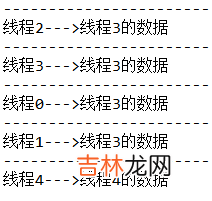
文章插圖
? 從結(jié)果可以看出多個線程在訪問同一個變量的時候出現(xiàn)的異常 , 線程間的數(shù)據(jù)沒有隔離 。下面我們來看下采用 ThreadLocal 的方式來解決這個問題的例子 。
經(jīng)驗總結(jié)擴(kuò)展閱讀









- 為啥有的票直達(dá)還得換座
- 冰凍的火鍋丸子煮多久
- 之八 2流高手速成記:基于Sentinel實現(xiàn)微服務(wù)體系下的限流與熔斷
- 8k和a3紙的一樣大么
- chrome工具調(diào)試
- 藍(lán)色糖心瑪瑙是天然的嗎
- 馬克筆和記號筆的區(qū)別
- 想開發(fā)DAYU200,我教你
- 火車z,k,c,t開頭的代表什么?
- 1.5*1.8的床多大 1.5米的床用多大的床單